

Branding by a mark
Being branded by a mark is not a recent trend but something that has existed in the past. Branding was carried on to denote ownership and claim proprietary rights. Marking livestock and goods with symbols to indicate ownership and quality dates back to ancient civilisations like the Egyptians and Babylonians. Potters, goldsmiths, and other artisans used marks to identify their work and ensure quality.
The word “brand” itself originates from the Old Norse “brandr,” meaning “to burn,” reflecting the early practice of marking cattle with hot irons. The branding of livestock served to establish ownership and deter theft. Brand marks are primarily visual, and often carry symbolic meanings that promote and represent the brand’s values, culture, or purpose.
Branding was also practiced as a “rite of passage”, e.g. within a tribe, or to signify membership of or acceptance into an organization.
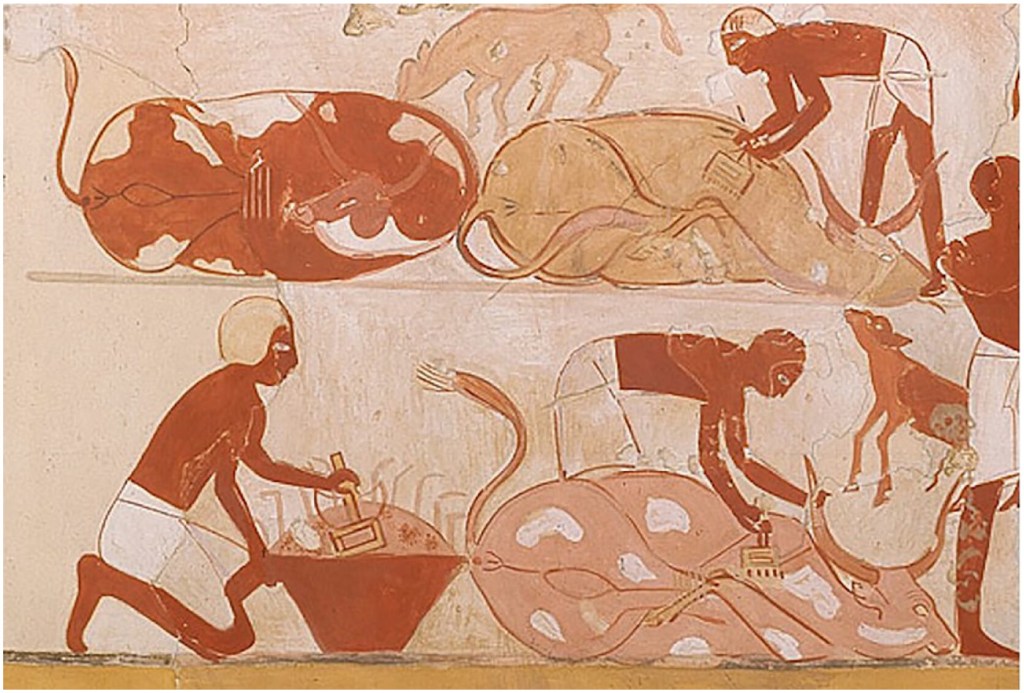
Human Branding
Human branding, also known as stigmatizing, is the practice of applying a mark, usually a symbol or pattern, to a person’s skin by burning or freezing it, leaving a permanent scar.
Branding of humans happened in situations of slavery and punishment, in ancient times in the Middle East. European colonial slavers branded slaves during the Atlantic slave trade, often multiple times to indicate ownership and for other purposes. Ancient Romans marked runaway slaves with specific letters, and convicts were sometimes branded and reduced to a slave-like status.
Ella Karev’s paper, ‘Mark them with my Mark’: Human Branding in Egypt, analyses the Aramaic and Egyptian textual evidence for marking enslaved persons in Late Period Egypt. She differentiates between branding and tattooing in that period, both existing as forms of body mutilation. However, these practices inhabited different spheres of social power, with branding marking one as property, and tattooing being religious and decorative.
It is no wonder that God prohibited the nation of Israel from cutting their bodies for the dead or putting tattoo marks since branding was an indication of ownership, and tattooing was seen as a cultic (and particularly feminine) practice in Aramaic cultures.

Identified by a mark
During the Nazi era, German authorities insisted that all Jews wear an yellow star. It served to stigmatize and humiliate them, segregating them, enabling watch and control over their movement, and also facilitated deportation.
God put a mark on Cain so that no man would kill him as the retributive justice of God assigned him to be a wanderer and fugitive for the sin of killing his brother Abel. Job complains to God of fastening his feet in shackles and closely watching all his paths by putting marks on the soles of my feet.
Job felt that God was watching him, monitoring every step he took, and even put marks on his feet to track him. This verse shows that Job felt a sense of being confined, and under the intense scrutiny of God. It was like being imprisoned or restrained, and unable to escape from the suffering and misfortune that had overtaken him.

Marked for service
Circumcision was given to Abraham and his generations as a mark they would carry to signify that they belonged to Yahweh, and were His covenant people.
When God brought Israel out of bondage in Eygpt, He gave them a set of directions and directives for a way of life. Living by these would set them apart as His people and cause them to showcase His glory before the nations. One of these was the way to treat servants and slaves. Every indentured servant or slave had to be set free on the seventh year, both from their debt and their servitude.
If however, a servant or slave says, “I do not want to leave you,” because he loves his master and his family and is well off with hem, they were branded by a mark. The master would go with him before the judges, and take him to the door or the doorpost and pierce his ear with an awl. He will be his servant for life, and the same thing was done to a female servant too.

Set apart by a mark
Such love slaves, as they can be called, were the ones who became trusted stewards and overseers of the house. Their loyalty to their master or mistress’s family made them above other servants, only slightly below sons and daughters.
These bond servants would often be entrusted with the grooming and care of their master’s children, carrying on their work for generations. With eyes and ears only for their masters, these love slaves waited only to do their owner’s bidding, took care of their family, and counted it freedom to serve their masters. They had their master or mistress’s trust, often their confidante and close ones, carrying out confidential tasks.
Eliezer and Abraham had one such relationship, and in the event of Abraham not having a child, Eliezer would have been his inheritor. It was to Eliezer that Abraham trusted the important task of finding a wife for his son Isaac, and Eliezer proved worthy of that trust. He relied on God to lead him, and chose Rebekah by his wisdom and God’s leading. By this he demonstrated his obedience, faith, and dedication to Abraham.

Being wrongly marked
In the New Testament, apostle Paul warns about being subjected to false teachings. Paul was always wary of anything that would take away from the sacrifice of Christ, and vehemently contended with those who sought to add to the gospel.
To the church in Galatia, he opposed those who insisted that pagans who turned to Christ submit themselves to circumcision and other elements of Jewish law. In his letter to the Galatians, he asks them not to entertain such false teachers since they did not uphold salavation by grace but mooted the gospel of works. Paul warns the church there that Christ would be of no value to them if they chose to be circumcised.
To the church in Corinth, he writes decrying those who came after him teaching a different gospel, possibly with Gnostic or other heretical influences. In his second letter to the Corinthians, he declares he is jealous with a godly jealousy for them so that they maybe espoused as virgins to Christ. He warns them of being deceived as Eve was, and led astray from their sincere and pure devotion to Christ.

Marks of Christ and the Apostles
In contrast to bearing the mark of circumcision, which was the mark of the old covenant and being obedient to the law, he declares to the church at Galatia that he bears in his body the marks of Christ. Though he was a Jew, his identity was now as the follower and slave of Christ.
In 2 Corinthians 12, Paul uses the term “super or super-fine apostles” with a degree of irony to describe individuals who were challenging his authority and teaching among the Corinthian believers. Answering their claims to being superior to him, he tells the church how he and his team, persevered to demonstrate among them the marks of a true apostle. In refuting them, he lists a number of things that happened to him in the ministry of the gospel in chapter 11.
When Jesus rose from the dead and met with His disciples, Thomas was absent. When told about it, he tells them “Unless I see the nail marks in his hands and put my finger where the nails were, and put my hand into his side, I will not believe.” Jesus appears later when Thomas is present and shows him the marks in his hands, feet, and side.
It evoked from Thomas such a profound response and passionate reaction that it led Him all the way to India to be martyred as His witness!

Branded as Christians
A brand mark is a powerful tool that’s a visual representation of the identity, values, and promise of the company. Symbolically, it represents the company and serves as a visual reminder of its values and attributes. It instills confidence, since it validates the authenticity of its products, and helps distinguish them from any and all counterfeits.
In Acts 4:13 we read: When they saw the courage of Peter and John and realized that they were unschooled, ordinary men, they were astonished and they took note that these men had been with Jesus.
In the book of Acts 11:26, we see that the disciples and followers of Christ were first called Christians in Antioch. According to Keener the people of Antioch were known for making fun of others and one way they did that was to assign labels to people. So they labeled the followers of Christ as “Christians” which literally means little anointed ones or little Christs.
The believers of that time decided to embrace that name because they truly wanted to become little Christs with all their heart and mind and soul and strength.
Christians, until recently, used to be known for industry, integrity, order, love, kindness, loyalty, unselfishness, without guile, etc.

People’s perception today
Over the course of the past 20-30 years the perception of Christians and the Christian church has changed drastically from respect and honor to an extremely cynical and apathetic feeling about Christians and the Christian church. Christians and the church are typically branded as being hypocrites, judgmental, fake, boring, unloving, unforgiving, snobby, they don’t listen, they’re greedy, you can’t trust them.
Christianity today has an image problem, with outsiders seeing it primarily negatively, and levelling accusations against its adherents. This means that we’re failing to live up to who we claim to be. We’re not living the way Jesus, the apostles, and the early church lived and behaved.
The perception that non-believers have of the church is very important when determining how we can help win them to Christ. Our individual, family, and community lives need toprovide the context for the content of the gospel, and the claims of Christ.
It is time we exhibited the marks of Christ and of true followers to a world watching us with doubt and cynicism. The world cannot believe until it is shown evidence of our faith and commitment.
Are we showing marks of being love slaves of Christ and His Kingdom? Or are we manifesting evidence of being of this world, and its persuasion?
According to 2 Corinthians 5:20, we are brand ambassadors of Christ. Do we truly give the right and visual representation of Christ’s identity, values, promise, and attributes? Are we able to inspire and instil faith and confidence in those who want to obey the gospel?
 MULLINGSPICE