
The Incident
A reflection on Mary’s extravagant worship and what it means for us today

The room fell silent except for the sound of breaking alabaster.
Mary had just shattered a jar worth nearly a year’s wages, pouring out pure nard — precious, fragrant, irreplaceable — onto the feet of Jesus. The perfume’s aroma filled the house, but so did the tension. Within moments, accusing voices and murmurings could be heard:
“What a waste! This could have been sold for three hundred denarii and given to the poor!”
It sounded so reasonable, so spiritual, so responsible. But Jesus saw something they missed entirely.
“Leave her alone,” He said. “She has done a beautiful thing to me.”

Two Definitions of Waste
This scene from Mark 14, Matthew 26, and John 12 introduces us to a collision between two completely different economic systems — two ways of understanding value, purpose, and love.
The world defines waste simply: anything more than necessary, more than logical, more than the minimum required. By this standard, Mary’s act was foolish extravagance.
But Heaven operates differently. In God’s economy, love always gives more. Love doesn’t calculate return on investment. Love doesn’t ask, “What’s the least I can give?” Love asks, “What’s the most I can pour out?”
Mary understood this. She gave her best, at the right moment, out of pure devotion. She recognized that some moments are too precious for practical calculations.

The Heart Behind the Criticism
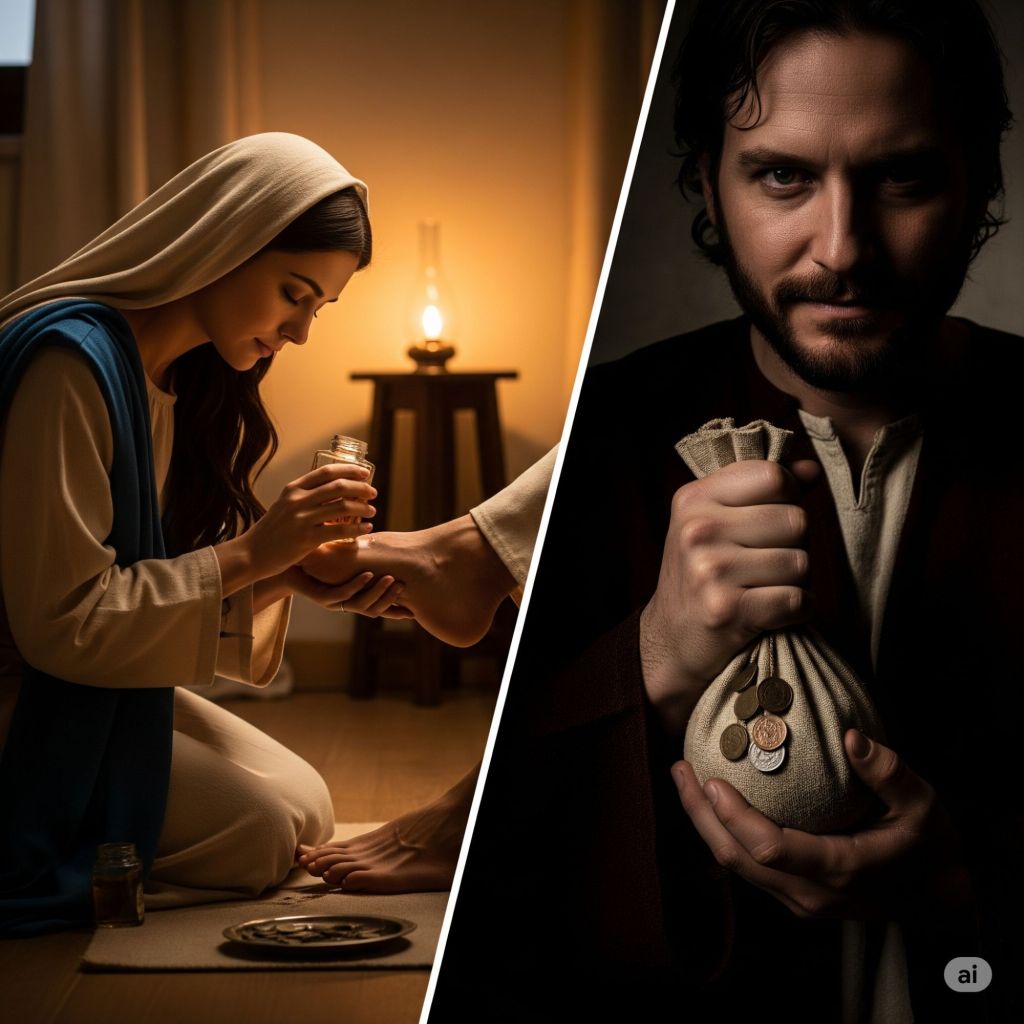
John’s Gospel reveals something crucial: it was Judas who led the criticism of Mary’s “wasteful” act. This wasn’t coincidental. Judas represents the calculating approach to faith —always measuring, always asking about the practical return, always giving the minimum required to maintain appearances.
Judas made his faith decisions based on profit and loss. Mary made hers based on love and worship.
The tragic irony? Within days, Judas would sell his relationship with Jesus for thirty pieces of silver — the ultimate expression of his transactional approach to faith. Meanwhile, Mary’s “waste” would be remembered and celebrated wherever the Gospel is preached.

What About the Poor?
Before we dismiss concern for practical needs, we must acknowledge that Jesus absolutely cared for the poor. His ministry was filled with acts of justice, mercy, and provision for the marginalized. The criticism of Mary wasn’t wrong because caring for the poor is unimportant — it was wrong because it missed the moment.
Mary’s example teaches us three crucial principles:
Timing matters. This was Jesus’ final week. There would be time to care for the poor after, but this moment was unique and unrepeatable.
Be led by the Spirit, not just by needs. There will always be needs, always be practical demands on our resources. The question isn’t whether needs exist, but what God is asking of us in this specific moment.
Good works cannot replace intimacy. We can become so busy serving Jesus that we forget to simply love Jesus. Mary chose the better part—again.

The Economics of the Kingdom
Living by Kingdom economics means embracing a fundamentally different value system:
Where the world asks “What do I get?” the Kingdom asks “Does this please the Lord?”
Where the world runs on profit, the Kingdom runs on love.
Where the world says “protect yourself,” the Kingdom says “pour yourself out.”
This isn’t about being irresponsible with resources or ignoring practical realities. It’s about recognizing that our ultimate allegiance isn’t to efficiency, security, or even common sense — it’s to Christ himself.

What We Need to Waste on Him
So what does this look like in our actual lives? What does God want us to “waste” on Him?
Yourself – Your plans, ambitions, comfort, and control. Paul said he considered everything loss compared to knowing Christ Jesus as Lord. What would it look like to truly live this way?
Your family – Instead of raising children just to be successful by the world’s standards, what if we raised them for His purposes? Instead of building families that serve our comfort, what if we built families that serve His kingdom?
Your resources – Move beyond asking “How little can I give?” to asking “How much can I give?” This isn’t about a specific amount—it’s about a heart posture that gives generously, sacrificially, joyfully.
Your dreams – Hold your plans loosely. Be willing to let God redirect, reshape, or even replace your dreams with His dreams for your life.
Your future – Stop trying to control and manage every outcome. Trust His leading, even when it doesn’t make sense to others—or even to you.

The Beautiful Thing
Here’s what strikes me most about Jesus’ response to Mary:
He didn’t call her act wise, practical, or strategic. He called it a good thing is something beautiful towards Him!
The Message version says something wonderfully significant for Him. Wonderful because it was extravagant — the giving was more than function required. Significant, because she did it at the right time, not before, not after, in time to prepare His body for burial.
When someone loves us extravagantly, we don’t critique the economics. We’re overwhelmed by the beauty and the goodness of it. We’re awed by it, and then transformed by it.
Jesus poured Himself out for us extravagantly. He didn’t give us the minimum required for salvation.
He gave us everything — His life, His blood, His righteousness, His future. He “wasted” Himself on us.
The gospel should produce Mary-like devotion in response – a joyful abandonment to Him that the world will call wasteful but Heaven will call beautiful.
The Choice Before Us
We all have a choice to make. We can live like Mary or like Judas.
We can approach Jesus with calculated giving or with abandoned love.
Mary walked away from that evening poorer in possessions but richer in relationship. She had broken her jar, spent her savings, endured public criticism — but she had pleased the heart of Jesus.
Judas walked away richer in coins but poorer in soul. His practical wisdom led him to betrayal and destruction.
Which path will we choose?

Your Alabaster Jar
Let me ask you directly: What is Jesus asking you to “waste” on Him?
What alabaster jar is He asking you to break? What sacrifice is He calling you to make that others will call foolish?
Maybe it’s your career plans. Maybe it’s your financial security. Maybe it’s your reputation, your time, your comfort.
The critics will always be there, ready with practical objections and logical alternatives. But don’t let them stop you.
Don’t let fear hold you back from the beautiful thing God is calling you to do.
Remember: He is worth it all.
He who spared not His own Son but delivered Him up for us all — He is worthy of our everything.
The world runs on profit, but the Kingdom runs on love. And love always gives more than logic demands.
Be like Mary, not Judas. Break your jar. Pour out your best. Give Him everything.
It may look like waste to watching eyes, but it will be beautiful to Him.
What is your alabaster jar? I’d love to hear your thoughts in the comments below. How is God calling you to “waste” on Him in this season of your life?
Scripture References:
Mark 14:1-11, Matthew 26:1-16, John 12:1-1, Philippians 3:7-8, 2 Corinthians 8:9
 MULLINGSPICE